Why topping a tree makes it more dangerous, not less
The cheapest quote on a big tree is often a topping job. Here is what you are actually buying.
September 2, 2026 · 3 min read
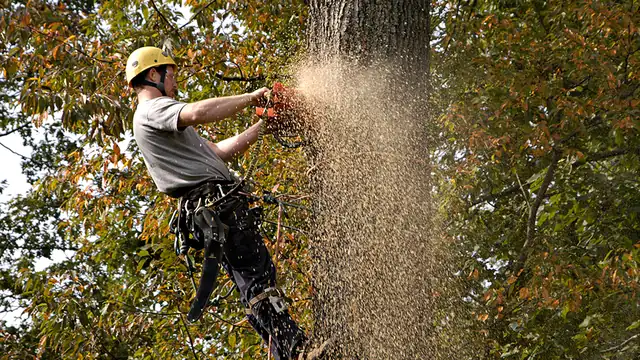
Somebody is worried about the size of the tree over the house. A quote comes back that is noticeably cheaper than the others and promises to take the top out and bring it down to a sensible height. It sounds like exactly the right answer to the problem.
It is not, and the reason is worth understanding before the saws come out, because topping is close to impossible to undo.
What topping actually does
Topping means cutting large limbs back to stubs, at a height chosen by eye rather than at any particular growth point. There is no live lateral branch left at the cut to take over as the new end of the limb. The stub is just an open wound with nothing beyond it.
A tree responds to that the way anything responds to losing most of its leaves at once. It has a store of energy in the trunk and roots and it spends it, fast, on getting foliage back. What grows are epicormic shoots: a crowd of long, fast, soft stems out of the wood just below the cut.
The shoots are the problem
A branch that grew normally is anchored deep in the wood of the limb it comes from. An epicormic shoot is not. It grows from buds just under the bark, and its attachment stays shallow no matter how big it gets.
Within five to eight years those shoots are limbs. They are as long as what was cut off, they are heavier, they are all growing out of the same weak collar of wood around an old wound, and that wound has been open the whole time and is very likely decaying underneath them.
So the tree is back to the height it was, with worse attachment and rot where the failures will happen. It is not safer. It is more dangerous than it was before anybody touched it, and it will need work again on a shorter cycle.
What to ask for instead
If a tree genuinely is too big for where it stands, the work is a crown reduction. Each limb is shortened back to a live lateral branch big enough to take over as the new leader for that limb. The tree keeps its shape, every cut has something living beyond it, and the wounds are small enough to close.
A reduction cannot take a tree down by half. Realistically it takes off a fifth to a quarter of the crown and it has to be repeated every few years. If somebody needs a mature tree to be half its size permanently, the honest answer is that the tree is in the wrong place and removal is the real option.
How to read a quote
- Ask what the cuts are being made back to. The answer should be a live lateral branch, not a height.
- Ask how much of the crown is coming off. More than about a quarter on a mature tree is a warning sign.
- Look at trees they have worked on before. A good reduction is hard to spot. Topping is obvious from the road for years.
- Be suspicious of a quote that is dramatically under the others on a big tree. Something is being skipped, and it is usually the rigging.
We prune to current ANSI standards, which is the industry's own written answer to exactly this argument, and part of that standard is that topping is not an accepted practice. It is not a house rule. It is the trade agreeing in writing that it does not work.
Stoudt Tree Professionals, (610) 372-6142
Call (610) 372-6142More articles
How to tell whether a tree actually needs to come out
Most of the trees we are called out to look at do not need removing. Here is how to work out which kind you have.
What happens to the wood after a tree comes out
A mature tree is several tons of material. Where it goes is a decision, and it is cheaper to make it early.