What happens to the wood after a tree comes out
A mature tree is several tons of material. Where it goes is a decision, and it is cheaper to make it early.
September 2, 2026 · 3 min read
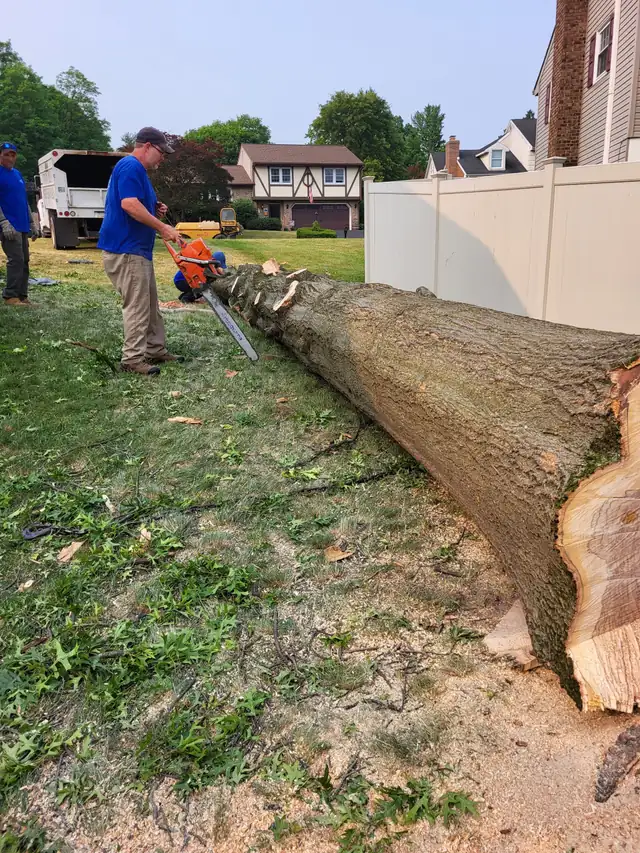
People think about the tree coming down. Almost nobody thinks about the fact that a mature hardwood is several tons of wood and brush that has to leave the middle of a garden, and that how it leaves is the single biggest variable in what your lawn looks like on the following Monday.
There are three honest options and they cost roughly the same. What they do to the property is very different.
Option one: all of it goes
Trunk wood on the truck, brush through the chipper and into the truck as well, site raked. This is what most people picture and it is the right answer when there is nowhere on the property you want any of it.
It also means the most traffic across the ground, because everything has to be carried or dragged to wherever the truck can park. On a soft spring lawn that is the part worth planning: where the truck stands, and what route the wood takes to it.
Option two: keep the wood
If you burn, say so before anything is cut. The trunk and the larger limbs can be cut to stove length as they come down and stacked where you want them, rather than being cut into truck lengths and loaded. It is the same work either way.
It has to be decided first, though, because stove length and truck length are different cuts and nobody wants to cut the same wood twice. One of our reviews is from a customer who had three trees cut to length for a wood stove on the same visit, which was a five-second conversation at the estimate.
Worth knowing: fresh wood is not firewood. Most hardwood needs a year split and stacked under cover before it burns properly, and oak wants closer to two. Green wood in a stove is how chimneys line themselves with creosote.
Option three: keep the chip
The brush has to go through a chipper regardless. It can go into the truck or it can go onto a tarp on your driveway, and the second one is free mulch.
Fresh arborist chip is excellent on beds and around established trees. Two or three inches, spread wide, pulled back off any trunk. It is not a soil amendment and should not be dug in, and it is not ideal against the stems of small ornamentals, but as a surface mulch on beds it is as good as anything sold in bags and there is a lot of it.
The same customer who kept the stove wood also had her pine chipped for mulch. Both decisions were made standing in the yard before the job started.
The stump is a separate decision
Grinding is a different machine and gets quoted alongside the removal so you can take it or leave it. Ground out, the hole gets backfilled with its own grindings and the lawn closes over it in a season. Left, you have a mower obstacle that softens and sinks over several years, and on some species keeps sending up suckers.
Say it at the estimate
- Do you burn? Then the wood stays and gets cut to stove length.
- Do you have beds to feed? Then the chip stays and goes where you point.
- Neither? Then all of it goes and the only question is where the truck stands.
- Stump: ground, or left. Decide with the quote in front of you rather than afterwards.
Five minutes at the estimate, and the crew makes one pass across the lawn instead of three.
Stoudt Tree Professionals, (610) 372-6142
Call (610) 372-6142More articles
How to tell whether a tree actually needs to come out
Most of the trees we are called out to look at do not need removing. Here is how to work out which kind you have.
Why topping a tree makes it more dangerous, not less
The cheapest quote on a big tree is often a topping job. Here is what you are actually buying.