How to tell whether a tree actually needs to come out
Most of the trees we are called out to look at do not need removing. Here is how to work out which kind you have.
September 2, 2026 · 4 min read
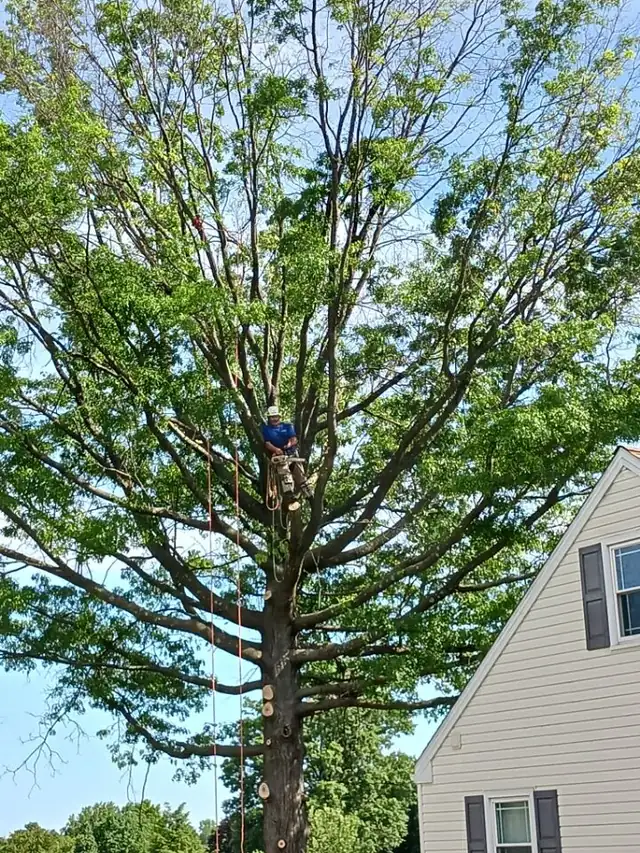
The call usually starts the same way. A storm went through, or a limb came down on the driveway, or a neighbor had a tree taken out and now yours looks suspicious. Somebody wants to know whether the big one at the corner of the house has to go.
More often than not, it does not. A crown clean is a fraction of the cost of a removal and fixes most of what people are actually worried about. But there are a handful of signs that genuinely change the answer, and every one of them can be checked from your own lawn without a ladder.
Start at the bottom, not the top
People look up. The information is at the base. Walk right up to the trunk and look at where it goes into the ground. You are looking for the root flare, the point where the trunk widens out like the bottom of a wine glass before it disappears into the soil. If you can see it, that is a good sign.
If the trunk goes into the ground like a telegraph pole, with no widening at all, something has changed the grade around it, or mulch has been piled against it for years. Neither is fatal on its own, but both keep the bark permanently damp, and that is where rot starts.
Then look for mushrooms. Bracket fungi growing out of the trunk or out of the ground within a couple of feet of it are the fruiting body of something that has been eating the wood inside for a while by the time you see it. That one is worth a phone call.
Then look at where the trunk divides
The single most common way a mature tree fails around here is not the trunk snapping and not the roots letting go. It is a split at a union where two large stems of roughly equal size meet at a narrow angle.
Look up at the first big fork. If the two stems leave at a wide angle, like a letter U, that is a strong join. If they run up almost parallel and meet in a tight V, with a seam of dark, in-turned bark running down into the crotch, the join is weaker than it looks and the two halves are slowly pushing each other apart.
Caught early that is often a reduction and sometimes a cable. Caught after a July thunderstorm has taken half the tree onto a roof, it is a removal and an insurance claim.
Then look at the top of the crown
The top is where a struggling tree shows it first. Bare, brittle limbs standing above an otherwise leafy crown mean the tree is losing its furthest extremities, which is what happens when the roots cannot supply them any more.
Two or three dead tips in an old oak is normal life. A ring of dead wood around the whole top, or foliage that came out thin and turned color a month before every other tree on the street, is a tree in decline. That does not always mean removal today, but it means somebody should look at it properly rather than reassuring you over the phone.
The four that usually do mean removal
- A crack or open seam at a major union that you can put a finger into.
- Substantial decay at the base, with fungal brackets and a hollow sound to a knock.
- A tree that has begun to lean where it did not before, especially with soil heaving on the opposite side of the trunk.
- More than about half the crown dead in a tree that also has damage at the base.
Any of those on a tree standing over a house, a driveway or somewhere people sit is a real conversation. On the same tree in the middle of a back field, it might be something you leave alone and keep an eye on.
And the ones that do not
Deadwood scattered through the crown is a crown clean, not a removal. A tree that has grown into the gutter is a reduction on that side. Suckers coming out of the base are usually stress, and worth understanding before doing anything drastic. A tree that dropped a big limb in a storm is not automatically dangerous, though the fresh wound is worth looking at.
Nobody should be talking you into a removal over the phone, ours included. Estimates here are free, Bob comes out himself, and reasonably often the answer is that the tree is fine and the deadwood over the driveway is a morning's work.
Stoudt Tree Professionals, (610) 372-6142
Call (610) 372-6142More articles
Why topping a tree makes it more dangerous, not less
The cheapest quote on a big tree is often a topping job. Here is what you are actually buying.
What happens to the wood after a tree comes out
A mature tree is several tons of material. Where it goes is a decision, and it is cheaper to make it early.