How a sixty-foot tree gets out of a fenced back yard
The most common question at an estimate is not whether it can be done. It is what the lawn will look like afterwards.
September 2, 2026 · 2 min read
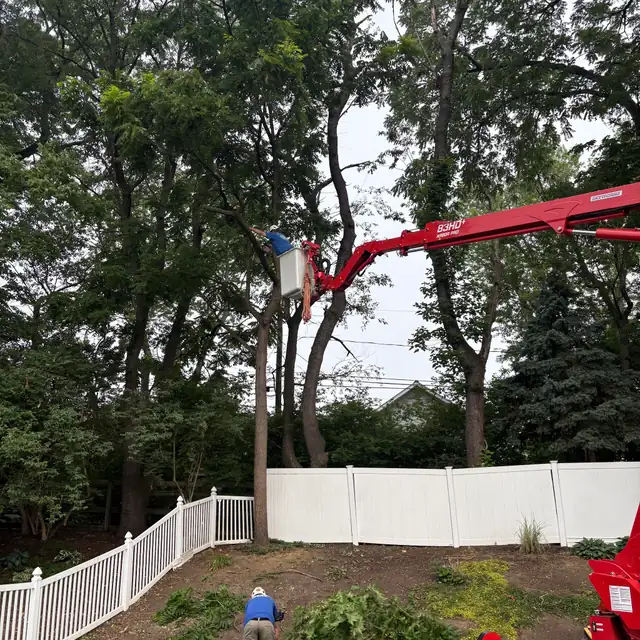
A tree in the middle of a field is a felling job. Notch it, back cut it, put it on the ground and cut it up. Most residential trees are nothing like that, because there is nowhere for sixty feet of hardwood to lie down.
What happens instead is that the tree is taken apart from the top, in pieces small enough to control, and every one of those pieces is lowered rather than dropped. That is most of what you are paying for, and it is why two quotes on the same tree can be so far apart.
The access question comes first
Before anything else, the question is how a person gets above the tree. There are two answers.
The first is climbing. Rope and saddle, up the trunk, working outward. It needs no access beyond a gate a person fits through, which is why it is the answer on a genuinely enclosed garden. It is also slower, and on a tree that is staying it is the only correct method, because spikes put a puncture wound every eighteen inches up a trunk that has to live with them.
The second is a tracked lift. Ours is an 83HD+ spider lift: it walks in on rubber tracks, fits through a side gate, sets its own legs on a patio or a driveway, and puts a bucket up over a fence and into the middle of the canopy. Where it fits, a two-day rigging job becomes a morning.
That is the whole reason the width of your side gate comes up at the estimate. It is not small talk. It is the price.
Then the tree comes apart in order
Small limbs at the outside first, working in toward the trunk, then the trunk itself in sections. Anything that cannot free-fall into a clear space gets a rope on it, run through a friction device at the base, so the piece is lowered under control by somebody on the ground rather than allowed to swing.
That is the difference between a limb landing on your lawn and a limb landing on your sunroom. It is also why there is always somebody on the ground: the climber cuts, the groundsman controls what the cut piece does next.
What gets protected
- Fence lines, sheds and greenhouses, which take a rope on the piece above them before the cut is made.
- Septic beds and drain fields, which is why the machine parks where it is told to.
- Irrigation, invisible-fence wire and low-voltage lighting, all buried at exactly grinder depth.
- The lawn itself, which is a question of how many times material is dragged across it, and therefore of deciding early where the wood is going.
And what it looks like afterwards
This is the part the reviews are actually about. Not the felling, which nobody watches. The chip raked off the grass, the stump ground and backfilled, the fence still standing where it was.
One customer had a big pin oak in a tight space, stump grinding included, and the whole thing took a day and a half. Another wrote that afterwards you would never know there were trees there. That is the standard, and it is entirely a function of decisions made before the first cut.
Stoudt Tree Professionals, (610) 372-6142
Call (610) 372-6142More articles
How to tell whether a tree actually needs to come out
Most of the trees we are called out to look at do not need removing. Here is how to work out which kind you have.
Why topping a tree makes it more dangerous, not less
The cheapest quote on a big tree is often a topping job. Here is what you are actually buying.